
innovate. grow, evolve.
INNOVATION
Where ideas become outcomes

Actively managing option quality and early advantage
Innovation is the disciplined creation of economically relevant, defensible options. It expands the future option set of the organisation and establishes the foundations for intrinsic and strategic value.
Architecture, IP posture, data strategy, regulatory positioning, and dependency choices made early often determine what becomes expensive — or impossible — to change later.
Most organisations over-invest in ideation and under-govern:
-
option selection and kill discipline
-
early protection of advantage
-
readiness for scale and regulation
As a result, Boards often approve “innovation” without clarity on:
-
which future value pools are being targeted
-
what must be proven before committing further capital
-
how much downside risk is being accumulated — and why
Innovation to Commercialization® reframes innovation as option governance under uncertainty, not creative activity.
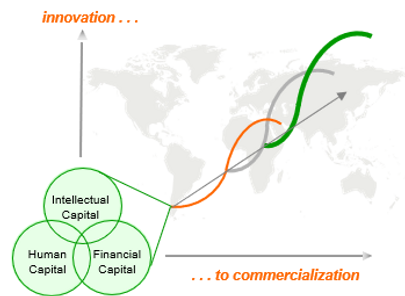
What Boards should demand from innovation management
At Board level, innovation should produce:
-
a prioritised portfolio of options explicitly linked to future growth curves
-
early evidence on feasibility, economics, and defensibility — not just technical progress
-
clarity on which options warrant protection investment and which should be terminated
-
visibility on the depth and duration of the cash trough associated with each option
The objective is not momentum. It is decision quality before irreversibility.
Actively governing early-stage decisions (Stages 1–4)
Before market entry, enterprise value is shaped less by scale and more by disciplined judgment under uncertainty. In Stages 1–4, value is largely expectation-based—derived from the credibility of the problem definition, the defensibility of the solution, and the coherence of the economic logic.
At this point, risk is structural: mis-sequenced investment, weak validation, unprotected intellectual capital, or premature commitments can embed fragilities that later growth cannot correct.
Deliberate governance during these stages converts exploration into evidence, assumptions into tested hypotheses, and technical possibility into investable confidence. It aligns human, intellectual, and financial capital around validated learning rather than optimism, preserving optionality while progressively reducing execution risk.
The objective is not acceleration for its own sake, but the creation of a robust foundation—one that can withstand market scrutiny, attract credible capital, and support scalable commercialization without hidden value erosion.

-
Ideation and Discovery: Whether options map to explicit value pools, credible strategic adjacencies, and durable sources of advantage — rather than novelty or internal enthusiasm.
-
Feasibility and Validation: Disciplined elimination of weak options, realism about regulatory, operational, and go-to-market pathways, and the active avoidance of “zombie” initiatives that consume capital without improving option value.
-
Development, Prototyping, and Protection: Active management centres on the depth of capital exposure, early unit-economics signals, and the timing of protection when negotiating leverage is highest and cheapest.
-
Pilot, Pre-Launch, and Certification: Focus is on evidence beyond early adopters: referenceability, robustness, and signals that scale will amplify value rather than conceal fragility.
Across these stages, the governing question is not “Is this progressing?”
It is: “Is this option becoming more valuable — or merely more expensive?”
Where value fails to compound
Innovation value begins to leak when:
-
options progress faster than evidence
-
defensibility lags technical progress
-
architecture constrains scalability or pricing power
-
build / license / acquire decisions embed structural dependency risk
Licensing may accelerate entry but compress margin durability.
Acquisition may accelerate capability but over-estimate synergistic value under integration pressure.
Weak innovation governance rarely fails at ideation. It fails at scale — when early assumptions harden and value leakage becomes visible.

Why innovation management shapes exit outcomes
Buyers do not pay for innovation pipelines, roadmaps, or activity levels. They pay for de-risked options with credible paths to scale, defensibility, and renewal.
Weak innovation management surfaces late as heavy earn-outs, sceptical diligence, and discounted forward multiples.
Strong innovation management creates option credibility long before exit is contemplated, shaping valuation outcomes well in advance of any transaction.
What this enables at Board and investor level
When Innovation to Commercialization® is governed deliberately:
-
EBITDA inflection becomes more predictable because execution capability is built ahead of scale
-
Cash volatility reduces through disciplined overlap and sequencing
-
Overlap between curves is funded rather than deferred
-
Renewal and transition risk is visible early, when it can still be shaped
-
Valuation reflects confidence in future curves, not scepticism about sustainability
How We Help
We partner with Boards, CEOs, and long-horizon capital providers to align Human, Intellectual, and Financial Capital as a unified enterprise value system. At each stage of the Innovation to Commercialization ® journey, we identify the binding constraint and realign decision rights, execution capability, and capital sequencing to preserve value continuity.
Innovation creates options.
Commercialisation realises value.
Human, Intellectual, and Financial Capital determine whether value compounds.
